
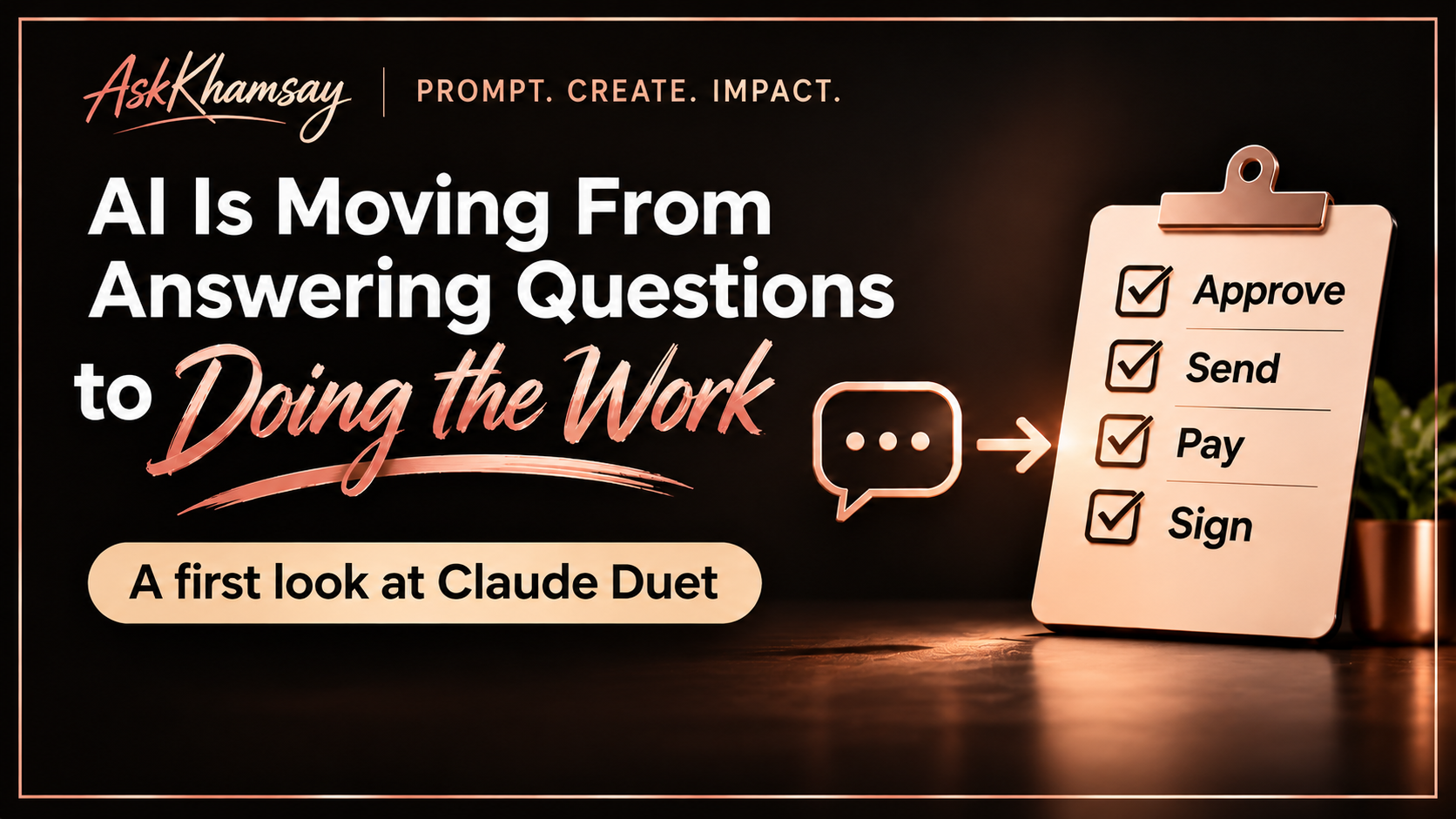
What if the AI stopped waiting for your next prompt and started bringing work to you?
And yes, I’m trying the new shiny thing. You know I wasn’t going to sit this one out.
I like new technology. I like testing new tools, poking around, figuring out what they can do, and occasionally wondering why nobody thought of this sooner.
But here’s what’s interesting about the latest wave of AI.
We’re moving beyond asking AI questions and getting answers.
We’re starting to give AI work to do.
For the last few years, we’ve been learning how to prompt. Give it context. Explain the task. Refine the instructions. Try again. Maybe threaten to start a new chat.
Now we’re seeing AI assistants take a more active role in how work gets done.
And that’s worth paying attention to.
Enter Claude Duet
I’ve recently started using Claude Duet, Anthropic’s new agent experience. It’s a research preview right now (US Pro, Max, and Ultra, waitlist), so features can still change.
I’m still exploring it, so this isn’t a full product review. I’m interested in what it can do, where it fits, and what happens when AI starts working beyond the traditional chat window.
Claude Duet is designed to be more proactive. It can prepare briefings, work across connected apps, help with tasks, and continue working in the background.
Think about the difference.
Instead of opening AI every time you need something, an assistant can help bring important information to your attention and move certain tasks forward.
We’re going from:
“Can you help me with this?”
To:
“Can you keep an eye on this and help me move it along?”
That’s a pretty interesting shift.
And yes, I’m going to have fun testing it.
But let’s not hand over the keys just yet
More capable AI also means we need to think differently about permissions and oversight.
An agent needs access to information and connected services to do useful work. That access needs boundaries.
Claude Duet requires approval for consequential actions such as sending, paying, signing, or deleting.
I like that.
I’m happy to let technology help prepare the work. I’m less interested in letting it make important decisions on my behalf.
Review the draft. Check the details. Approve the action.
Call me particular. I prefer knowing what leaves my inbox and what happens with my money.
Here’s where my Microsoft 365 experience comes in
I’ve spent nearly 30 years working in technology, with much of my work centered on Microsoft 365, SharePoint, Power Platform, and helping people make technology useful.
So when I look at AI agents, I don’t just see a cool new tool.
I see workflows.
I see information management. Permissions. Approvals. Data quality. The everyday processes that either help people get work done or make them question their career choices.
Before a business introduces AI agents, it should understand the work those agents are being asked to handle.
Are files organized? Are permissions appropriate? Are processes documented? Do people know what information can safely be shared?
An agent isn’t going to magically fix a broken process.
It might just help you break it faster.
One important distinction: Claude Duet does not currently support Microsoft 365 connections. The regular Claude app does have a Microsoft 365 connector for work or school accounts, including Outlook, SharePoint, OneDrive, and Teams. But there’s an administrative setup process before organizations can use it.
Different Claude experiences. Different capabilities.
That doesn’t make Duet less interesting. It means we need to understand what each tool actually supports instead of assuming everything connects to everything.
I’m watching where this goes
I don’t think we’re done learning how to work with AI.
We’re just getting started with a different kind of assistant.
I’m interested in testing these tools, finding the useful parts, understanding the limitations, and sharing what I learn along the way.
Because the goal isn’t to use AI just because it’s new.
Although, let’s be honest, new technology is fun.
The goal is to figure out where it saves time, improves the work, and gives people a little breathing room.
My advice?
Stay curious. Try the tools. Ask better questions. But keep your judgment switched on.
The more an AI assistant can do, the clearer our instructions and boundaries need to be.
And that’s a conversation worth having.
Don’t guess. Ask Khamsay.
PROMPT. CREATE. IMPACT.
Paid Claude user; not affiliated with Anthropic.